August 09, 2019

Iron Reign Event – which deck to play?

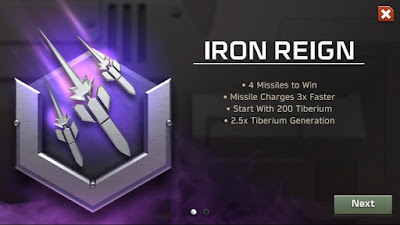
Today, a fun new event / game mode started in Rivals: Iron Reign.

How does it work?
  • 4 Nukes / Missiles instead of 2 to win
  • Missiles charge faster (12 seconds instead of 40)
  • Players start with 200 Tiberium instead of 100
  • Tiberium income (base + harvesters) twice as fast
What to play? 

Initially, I thought Tech should be the way to go. You can instantly go double harvester and a scout unit, and then quickly get money for your tech units.

But after some games, I realized that this is inferior to more aggressive strategies, as the overall pace of the game is so fast. 

I now ended up with a no-harvester Nod deck:
  • Militants
  • Scavengers
  • Cyber Wheels
  • Bikes
  • Scorpion Tank
  • Stealth Tank
  • Seth as Commander
The idea is to play no harvester, and instantly rush the middle with 3-4 units, e.g. one each of Scavenger, Wheels, Militants and Bike. Try to charge the nuke as quickly as possible and maneuver against the opponent's force. Keep pads charging all the time and try to do favorable trades. 

Seth, Scorpion and Stealth Tank are just situational as counters (e.g. Scorp against Chem Buggy, 

The mixture of short game, double income even without harvester and the Scavenger income means that you don't really run out of units, as you have so many cheap units to build/spam.

With this deck I now went 20-3, and all 3 losses were games where I accidentially built a harvester (yes, wasn't very focused). 

Now, I'm not saying that I would be at 100% win record without building harvester first. And I'm not saying that this is the strongest deck in this event. I partly just didn't meet very strong players.

But maybe this inspires you to try this deck, or other aggressive no-harvester decks.

August 08, 2019

Balance Changes August 2019 – patch notes

These changes are live since a week. As I was on holidays, this blog post is a bit late. Apologies.

Buffs
  • Banshee cost reduced from 60 to 50
  • Stealth Tank speed increased from fast to fastest, hitpoints increased by +9% and cost increased from 90 to 100 Tiberium
  • Orca reload time decreased to 9 seconds from 10 seconds
  • Tick Tank cost reduced from 80 to 70 Tiberium and attack speed increased by +7%
  • Jade Catalyst Missile cost reduced from 90 to 80 Tiberium
  • Widow Maker air attack speed increased by +7%
  • Flame Tank speed increased from average to fast, cost decreased from 110 to 90 Tiberium and structure damage decreased by -29%
  • Basilisk turn speed increased by +66%
  • Rock Worm speed increased from slow to average
  • Avatar damage against vehicles +9%, damage against infantry +7%

Nerfs
  • Nod Laser Drones attack speed reduced by 25%, vehicle damage reduced by 13% and harvester damage increased by 
  • Artillery firing frequency reduced by -8% and damage to vehicles reduced by -20%
  • Liang healing drone cooldown increased from 30 to 35 seconds
  • Slingshot cost increased from 40 to 50 Tiberium
  • Zone Trooper infantry damage reduced by -16%
  • Scarab cost increased from 30 to 40

Nerf/Buff combined
  • Solomon Ion Cannon damage now gradually decreases with distance from the center tile. This is a buff when you want to snipe a specific unit, but it is a nerf with regards to the damage to outer-tile units which try to dodge the strike

Thoughts on the patch
  • Mostly, a sensible patch in my view. Especially the buffs seem all okay. Interesting to see how viable e.g. the Tick Tank might become.
  • The Artillery changes makes it e.g. a bit easier to try to flank an artillery position with multiple tanks.
  • Nod Laser Drone nerf seems too much. It's an anti-vehicle specialist and their vehicle DPS was nerfed by a whopping 41%! Yes, they were strong, but this is an unnecessary harsh nrf.
  • The Scarab nerf is of course a bit ridiculous, as (at high-level play) they are one of the weakest units in the game. Yes, they might have been frustrating for newer players, but I'm in the camp that they are a good learning experience for newer players to teach them why it's good to scout and have some cheap unit in your deck. On the other hand, as they saw little play anyways, it's not really a relevant nerf.
  • The biggest issue is that the patch was not communicated to players! Yes, Captain Benzie was sent the notes so he could make a video out of it, but that was it. There's tens of thousands of Rivals players, and Captain Benzie reached 2,700 views with his video. Yes, probably most active Tiberium league players got note of the patch through Reddit and Discord. But it's especially the newer players who were grossly neglected. For these newer players, Rivals can anyways already feel frustrating (as they usually play against higher levels). If then suddenly their units behave differently and they have no idea why, this is a big f***-up.  In my view, there is no excuse for this. The patch notes existed, and posting them through an in-app message would have been a (max) 30-minute job for the developers or product manager(s).

Video of the day

13lade is not just one of the best Rivals players, but also creates hilarious videos that showcase unusual strategies. I very much enjoyed this video:


July 30, 2019

Dear Devs, we need more Events again!

Ever since Races were introduced in early June, the frequency of other Events has been reduced.  On first sight, this might be understandable if you think about it from a scheduling perspective.  But I see three issues with it:
  1. Races are no real events. For many players, Races don't feel like a proper event. At the end of the day, it's just playing ladder with an additional incentive.
  2. Incentive to play less. Races, as various people in the community brought up, can even set wrong incentives for people to play less or lose intentionally, to get to an easier race.
  3. Bad for developers. Less Events means less Diamond sinks. Experienced players will not buy the normal offers. But they often buy Event reruns and premium tracks. I'm a good example, having re-run the last Resources events as often as my time allowed.
What makes Events so cool?
  • They mix up our Rivals experience, especially the Cabal War Games and the latest new Showdown events. But even more "normal" events are cool due to the option to specialize your decks on a limited set of 1-3 maps.
  • There are players who are frustrated by ladder. Events gives them an outlet, which keeps up the motivation.
  • They are a great way to measure your skill even if you're not (yet) having higher-levelled units.
  • They make spending money more fun, as your own performance influences what you get for reruns and premium track.
Showdown is a great event format that really feels fresh

So, what is my recommendation to the developers?
  1. Up the schedule from currently less than 2 to more than 2 events per week (see July schedule, 8 events for 31 days are 1.8 events per week)
    • If necessary, dilute the free track rewards to keep your goals for the economy intact
  2. Run fewer Races (maybe 2 per month) and only use vanity items for the Races
    • By redistributing the crate rewards from Races to Events, the economy balance can stay intact without reducing rewards per event
With 11-12 instead of 8 events per month, we'd have 22-24 days of events in a month, which allows for a greater diversity of play, more motivation, and likely also more Diamond purchases, as Event reruns and premium tracks should be a key Diamond sink at least for a pretty significant part of the player population.

CABAL War Games also is a fun mode that mixes up the playing experience

Tiberium income acceleration during a match – how does it work?

In Rivals, the Tiberium income increases over time during a game. Experienced players will have noticed that, but few really understand how it works. Especially as it's not documented by the devs.

In the interview with Omeleet and StrikerVX, I added a graphics that reflected Omeleet's best understanding of this acceleration back then. When I re-used that graphics in my latest post on the basic principles of deck building, Omeleet wrote me that he today has a better understanding of this concept.

TheCopyCatTV (follow him on Twitch) and Omeleet (follow him on Twitch) measured this increase more precisely and thankfully shared the data with me. Here it is:
  • Base income starts at 2 Tiberium per Second (T/s) and accelerates by +0.2 T/s every 30 seconds up to a max of 3 T/s
  • Income per harvester (that is actually harvesting) increases from 1.5 T/s at the start of the game to a max of 4 T/s at 150 seconds, an increase of 0.7 T/s every 30 seconds
We can also display this differently as a table and summarizing the Base Income and Harvester Income:

Tiberium income over the course of the time

Observations:
  • Base income accelerates only by +50% over the course of the game
  • Harvester income accelerates by +166% over the course of the game
  • This means that the income gap of 0 vs 1 vs 2 harvesters grows over the course of the game
  • A harvester that you build at the start of the game amortizes after 37 seconds plus the time before it starts harvesting, so about 40 seconds
  • A harvester that you build at 60 seconds amortizes after 21 seconds
  • A harvester that you build at 120 seconds amortizes after just 14 seconds
What can we learn from this?
  • A zero harvester player has no total Tiberium downside for the first nuke if he manages to continously charge the nuke. Combined with the increased pop cap, a zero harv deck has a strong early game advantage. But For the second nuke, it's at just half the income already!
  • In a close game, and with a deck that can work on 1 or 2 harvesters, it can be an option to build a second harvester even after the second nuke. It amorizes quickly enough to have an impact. Of course, there's the trade-off between pop cap and Tiberium, so it depends on the deck and situaiton
  • Generally, it might be an underused idea to fight for the first nuke on a single harvester and then, when the opportunity arises (e.g. after the first nuke), build a second harvester. 
    • Many tech decks do have some cheap units to contest the first nuke, and the additional pop cap of not building the 2nd harv early might come in handy. 
    • The Tiberium income lost from not having the 2nd harvester for the first 60 seconds is below 100 Tiberium (considering you can't build it immediately at 0 seconds). This compares against an income of this second harvester of 150 Tiberium during the second minute and nearly 240 Tiberium in the third minute.
  • Even if you don't win the first nuke by delaying the 2nd harvester, it can still be worth it. If you manage to stall it for an additional 30 seconds, you will have 30 seconds more of the higher income tiers. The 30 seconds more after 120 seconds would mean +130 Tberium, which is more than the <100 Tiberium the 2nd harvester would net you in the first minute of the game.
I believe that the more this concept is understood, the more we will see decks that start with a single harvester and build the 2nd harvester opportunistically and situationally. This can already be seen if you watch strong players play Tech decks or Tech splash decks, they usually don't start with 2 harvester straight away.

Of course this only makes sense if you can realistically contest the first nuke. If you delay the 2nd harvester to about the 60 second mark, you need to delay the first nuke by at least 20-25 seconds on average to make it worthwhile. That's why it's probably still rational for players with limited micro skills to build the second harvester instantly, orimmediately after scouting for a hard rush.

Further reading:

July 23, 2019

Basic deck construction principles for Rivals (Nod + GDI)

Newer players, or experiences players who want a change, often ask for new deck ideas, or what the current "meta deck" is. In this article, I want to cover deck construction rather than to tell you what "the best deck" for Nod or GDI is. The reason for that is that through balance changes, and shifts in the meta, the answer for "the best deck" is not a singular one and will change over time.

Fundamental principles about deck construction are:
  1. You need at least one counter for each unit type (infantry, vehicle, air)
  2. Ideally, you want multiple counters for the same unit type from different armor types. For example, you want an infantry unit that is good against infantry, and a vehicle unit that is good against infantry. Reasons for this:
    • Being able to hard-counter. Opponent has Flame Troopers? Your own Flame Troopers can counter them (they are a soft counter), but not too effectively (especially in offense). Your Cyber Wheels on the other hand are a hard counter: They deal most damage against infantry, and are a vehicle, which takes little damage from Flame Troopers.
    • Being able to react to what the opponent has on the field. Say your opponent has a Chem Buggy and 2 Laser Squads on the field. You can build Militants against this, but the Chem Buggy can kill them quickly. If you can build Venoms, which can't be attacked by Chem Buggies, you have a potentially better option.
  3. Ideally, you want counters at different price points. Say you have two units for a generally similar purpose, it's good if one is cheaper and one is more expensive. This has two reasons:
    • General flexibility. If every opponent's Rifleman always forces you to build Flame Troopers, you spend 40 to counter 10. If you also have Wheels in the deck, you can counter the Rifles for 10 Tiberium of your own.
    • Accelerating Tiberium Income. Throughout the game, Tiberium income accelerates. That means it's useful to have cheap units especially for the early game. And it's useful to have some way to spend your money on more powerful units later in the game. Yes, you can always counter a Flame Trooper with 2 Rifles cost-efficiently (40 vs 20 Tiberium), but usually the Pop Cap (limit to units on the field at the same time)
  4. You need to understand the pace and goal of your deck. What is your win condition, especially against very different decks? 
    • Do you need to win the first two nukes against a Tech deck? Then you need a lot of flexibility with cheap units to dominate the early game. This can speak for taking in both Militants and Cyber Wheels into your deck as cheap 10 Tiberium infantry counters.
    • Or does your deck (need to) allow you to fight for a third Nuke against strong units the opponent might have? That is a reason to include a strong enough counter for late game units, e.g. you might struggles against Zone Troopers and Cyborgs if your only anti-infantry options are Militants and Cyber Wheels.
    • Or do you even want to prolong the game because you believe you have the better end-game composition? That might mean that your endgame unit is a great counter against even multiple unit types, such as Mammoth Tanks against vehicles and infantry. And it might mean that you outside of this unit want to be able to defend and stall with cheap units to save up for your Mammoth.
  5. You need to understand what good & bad units (and commanders) are. Yes, generally, the developers try to balance the game to make every unit useful. But this will never be perfect for a number of reasons:
    • Balance changes like the most recent one (this post is from July 2019) can make units stronger or weaker every month.
    • Certain units might be strong against inexperienced players. This often means that they are bad against strong players, because they need to be balanced for all players. An example would be Scarabs, which can feel scary for new players, but are generally seen as one of the worst units in the game at high-level play.
    • To get an idea for weaker or stronger units (and maybe get inspiration for specific deck ideas), you can check my monthly Top 50 reports, where I analyze the decks of the Top 50 players in the ladder, and which units they play how frequently. You can find the July 2019 versions here: Nod, GDI. You can find the latest version in the side bar.
    • A key aspect of "good" is "maneuverability", which can be broken down to:
      • Speed: Allows you to quickly capture / contest pads. It allows you to quickly disengage from an unfavorable matchup (e.g. Scorpion Tank running away from Missile Troopers). It allows you to quickly reposition units (e.g. swap two adjacent units) to let them deal with the right opponent units (e.g. you switch your Bikes and Missile Squad to allow the Bikes to attack the opponent Chem Buggy whilst protecting your Missile Squad from it)
      • Attack Type: Most units need to stop to fire. Some units like the Pitbull and Tanks can fire while moving. This ability is called "Raider". It allows you to maneuver more without losing your shots (if you maneuver a lot with, say, Flame Troopers, they won't make much damage).
      • Air/Hover: Can the unit hover over lakes, fly over rocks?
An illustration of the accelerating Tiberium income throughout a match, in Tiberium / second

Let's apply these principles in practice to a Nod deck!
  1. We want two good counters against Infantry, Vehicles and Air.
  2. Our opening buildings (Infantry & Vehicles) ideally contain a counter against each, so we can counter early all game threats. This automatically means we also have counters to all unit types from two different buildings.
  3. The counters should be at different price points, but all be rather not that expensive, as we want to play with a single harvester.
This gives us:
  • Infantry: Laser Troopers (20 Tiberium, good against Air and Vehicles), Flame Troopers (40 Tiberium, strong against Infantry)
  • Vehicles: Cyber Wheels (10 Tiberium, good against Infantry and much cheaper than Flame Troopers), Bikes (30 Tiberium, good against Air and Vehicles), Scorpion Tank (70 Tiberium, strong against Vehicles)
  • Air: Banshee (50 Tiberium, good against Air and Vehicles).
  • Commander: Seth or Oxanna. Seth is considered better here generally, allowing you situational infantry counter and the option to take over / contest pads "remotely". Oxanna can be used well especially on the Scorpion Tank, and the Banshee.
Strengths:
  • This gives you a good set of mostly cheap and mostly fast counters to all unit types. 
  • It allows you to deal with all situations in the early- and mid-game.
  • It still has reasonable counters against all units as long as they appear independently (e.g. you can counter Kodiaks with Banshees and Lasers, you can counter Zone Troopers with Flame Troopers etc.)
Weaknesses and how to play around them:
  • You will not be strong against a good setup around a key unit like Giga, MLRS or Artillery.  This means you need to keep map control (vision of most of the map to see what the opponent is building when) and to strike quickly if the opponent tries to build such a setup.
  • You will not be strong against a good late game composition (say, Zone/Disruptor). So you need to make the game fast, and try to always keep the pads charging so the game ends as quickly as possible (remember, Tiberium income accelerates throughout the game, so the player with strong late-game units will benefit from the game taking longer).
How to build variants of this deck:
  • You can replace Flame Troopers with Militants. This gives you a bit more control and options in the opening moments of the game, and you save some Tiberium to e.g. get a Tank out quicker. If you do this, you have even more reason to play Seth over Oxanna, as it gives you additional anti-infantry power. This variant is popular since many months and highly viable.
  • You can replace Laser Troopers with Scavengers. They are more expensive, but a bit faster and can earn you money back. The extra money isn't critical for this deck, as it has few ways to spend a lot of money. So usually this is not done, and such a replacement makes more sense in decks with more expensive units (say Inferno/Phantom or Tech)
  • You can replace Cyber Wheels with Buggy. This is in today's balance not recommended. The buggy has less vision, and costs 30 instead of 10. It dies quickly against tanks and still dies vs anti-vehicle air (like Mohawk, Laser Drones).
  • You can replace Banshee with Phantom. This means you have less options aginst e.g. Giga Cannon, MLRS, Artillery (but often, Banshee anyways doesn't cut it against them, set up and protected properly). And you might miss the Banshee in situations where the opponent builds many Tanks. On the upside, you get an air superiority unit that is better against e.g. Inferno or Orca Bomber.
  • You can replace Militants with Fanatics. The idea is to have Fanatics die next to other units, especially Scorpion Tanks, which gives them a boost. This is then often combined with also replacing Banshee with Phantom and Seth with Oxanna. Before I get into the logic of that, better watch this video where top Rivals player 13lade explains these options in detail:

Now, your homework is to think about the same logic for GDI. What would be a good default deck that covers all bases? How could you make variants within it?

This is just a starting point for newer players. There's way more options and nuances in deck building. Just to mention some that are not covered in this post:
  1. Building deck around other key ideas like Air decks with 2-3 air units, e.g. the Nod Inferno/Phantom deck variants.
  2. Building decks around key anchor units like Artillery or Giga Cannon. You can watch this video on the "Airtillery" deck as an example.
  3. Building decks around super units like Avatar or Mammoth (they kind of become your "win condition").
  4. Different Harvester builds. This post focuses on classic "single harvester" decks. You can build two harvesters, or "situational single or dual harvester" decks. And even "zero harvester" decks are an option.
  5. Impact of maps on decks, i.e. which maps are more or less suitable for certain decks. This becomes important in Tournament Play, where you know in advance which map you will play next.
If you have any feedback or questions, let me know!

July 21, 2019

GDI War factory works overtime – Top 50 Deck Analysis July 2019

Welcome to the monthly Rivals meta analysis: What units and commanders do the top 50 players in the ladder play? This time, I released GDI and Nod data at the same time, you can find the Nod version here.
  • Please find the raw data here, incl. a full list of the decks including nicknames, if you want to find a player who plays a certain unit or deck.
  • Average deck level was constant at 13.5, which could indicate that players switched units (that are not as levelled-up) or that new players made their way into the top50. The first aspect does play some role, as we see quite some under-levelled Scatterers and even MSVs.
  • 1.9 infantry (-0.2), 2.0 vehicles (+0.2), 1.0 air (-0.3) and 0.8 (+0.2) tech units make up the average deck (changes to last month in brackets)
Now to the main data, the unit frequency. How to read the table below:
  • "Frequency" is the share of Decks that run this unit or commander. First, the frequency in % over last 4 months is shown. Then, a bar chart visualizes the June frequency. Third, there is a small line chart that shows the trend over the last 4 months.
  • "Δ vs average winrate" is how the winrate decks utilizing this unit/commander deviates from the average (e.g. Sniper decks had a 7 percentage point higher winrate than the average deck)
  • "Δ vs average levels" is how the levels of decks utilizing this unit/commander deviate from average (e.g. decks utilizing the Shatterer are -0.9 levels under the average)

Observations:
  • Winners
    • Slingshots tripled in usage to 30%
    • Shatterers made a strong w
    • War Dogs made a comeback and are now at 38% usage, likely driven by the overall shift to war factory
    • MLRS made a small comeback, especially in decks that are very factory-heavy. Maybe this was also inspired by the SHOWDOWN event, where MLRS were a key unit for most GDI builds
    • Every fifth deck now contains a Mammoth Tank, the most expensive unit in Rivals
    • Titans are now seen in a surprising 10% of the decks
    • Mohawks nudged up from 8% to 14%, possibly from players looking for an alternative to Orcas
    • Zone Troopers and Wolverines went up to 14% each, showcasing that Tech overall did become more viable with the latest changes
  • Losers
    • Orca fell from 34% to 14% after it was nerfed
    • Droneswarm went from 38% to 16%
    • Unsurprisingly, this also means the APC went down, as the meta APC deck relies on support from both Drones and Orcas.
    • Pitbulls fell from 80% to 60%, likely more due to the rise of the Slingshot than due to their recent nerf
    • Usage of Grenadiers and Snipers went down, yet the decks that still utilize them sport strong winrates

Unit Type Distribution

This chart shows how many decks contain how many units from which building. 
  • Few decks do without Infantry, and >50% have exactly 2 Infantry
  • There's even decks with 5 or 6 vehicles, thanks to the newest GDI units Slingshot, Shatterer and MSV
  • There's only few Air decks left in GDI (i.e. decks with 3+ Air units)
  • Tech has gotten more frequent and comes in many different forms

Nod Air took off this Summer – Top 50 Deck Analysis July 2019

Welcome to the monthly Rivals meta analysis: What units and commanders do the top 50 players in the ladder play? This time, I released GDI and Nod data at the same time, you can find the GDI version here.
  • Please find the raw data here, incl. a full list of the decks including nicknames, if you want to find a player who plays a certain unit or deck.
  • Average deck level went up from 13.4 to 13.6, and there's 6 full-L15 decks in the top 50
  • 2.0 infantry (-0.1), 1.8 vehicles (=), 1.6 air (+0.3) and 0.5 (-0.1) tech units make up the average deck (changes to last month in brackets)
Now to the main data, the unit frequency. How to read the table below:
  • "Frequency" is the share of Decks that run this unit or commander. First, the frequency in % over last 4 months is shown. Then, a bar chart visualizes the June frequency. Third, there is a small line chart that shows the trend over the last 4 months.
  • "Δ vs average winrate" is how the winrate decks utilizing this unit/commander deviates from the average (e.g. Inferno decks had a 10 percentage points higher winrate than the average winrate)
  • "Δ vs average levels" is how the levels of decks utilizing this unit/commander deviate from average (e.g. the Avatar users used had a 0.9 higher deck level than the average level)

Observations:
  • Winners
    • Scavengers made a strong entry now after people levelled them up. 36% of all dekcs use them. And this is despite the recent nerf
    • Militant usage is at an all-time high, coinciding with the decline of wheels and increase of air usage
    • Laser Drones, after their hefty buff, unsurprisingly went up a ton from 4% to 32%
    • Venom the same, from 15% to 40% after being buffed. 
    • Phantom also jumped from 11% to 30% and is popular in Artillery decks, Inferno-decks and and in 3-air decks
    • Artillery, despite it's nerfs, grew in popularity -- usually as the single tech unit (aka "Tech splash")
    • Jade became more popular with a jump to 22% of decks. 9 of the 11 Jade decks utilize the Laser Drone. This could help explain the growth of Jade: First, Jade is an expensive commander so benefits from a cheap efficient unit from a different building that the opponent has to counter. Second, they can relatively easily get to opponent's base to add some chipping damange and get vision for the Jade missile
  • Losers
    • Lasers dropped from 83% to 56%. Because who would have both lasers and Scavengers in their deck?
    • Wheels fell from 66% to 32%, mirroring the raise in venom and the general replacement of Vehicles with Air in many Nod decks
    • Scorpion tanks continued their decline from 88% in March to now 42%. This is mostly due to the current air meta, e.g. Laser drones are a strong counter to them
    • Marauders declined from 21% to 8% and Chem Buggies from 21% to 14%, as the "Marauder Chuggy" combo fell a bit out of the meta

Unit Type Distribution


This chart shows how many decks contain how many units from which building. 
  • Nearly all decks contain some infantry, most of them 2
  • Vehicles are the most common building type to have 3 units in a deck
  • Air play sees most diversity from 0 to 3
  • There's about a third of unit with at least one tech unit